

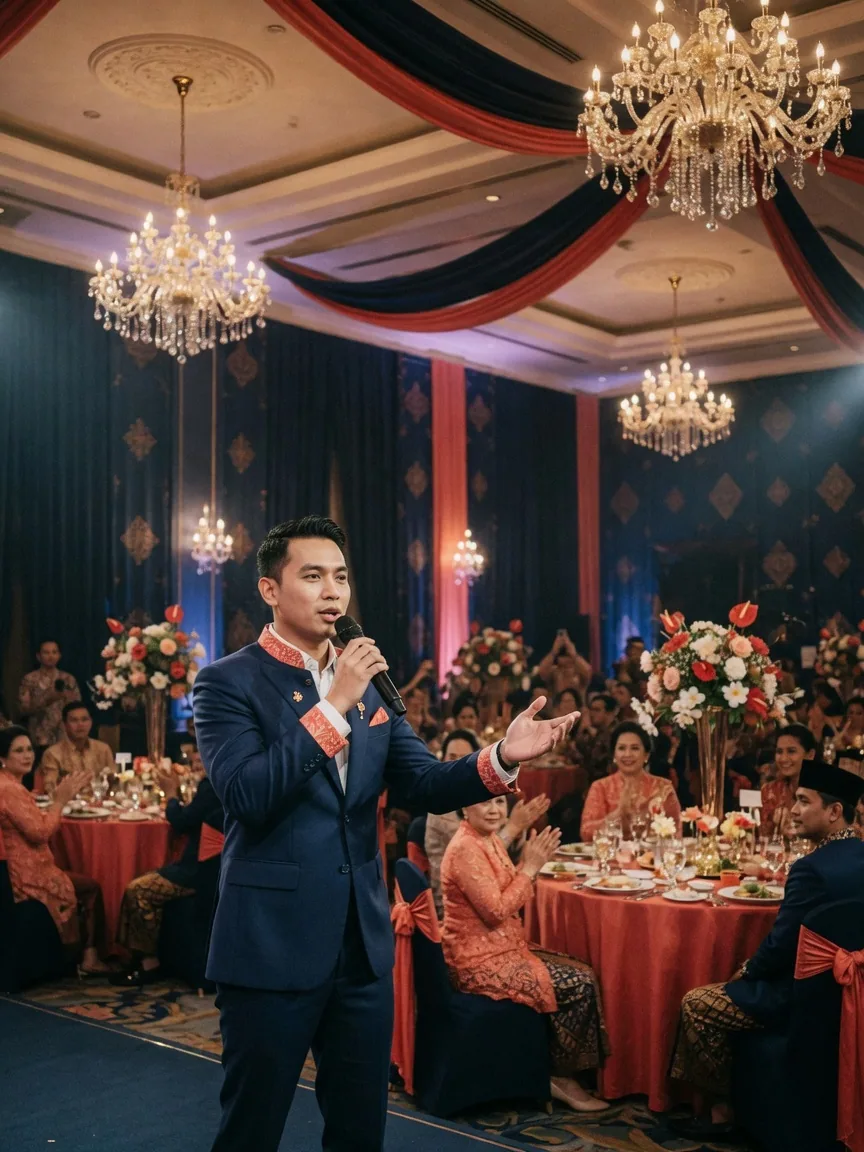
PROFESSIONAL MC
Professional MC classes in Indonesia
Hosting an event means holding other people time. You practise a clean running order, linking lines that flow, and how to recover the thread when an event slips, because events do slip.
- Experienced trainers with expertise in their field
- Practice uses running orders from real events
- You move up once your level target is met
What is Professional MC class?
A professional MC class is practice in hosting an event from open to close, covering how to build a running order, link the segments, and recover the thread when the schedule shifts. At Retora the route runs through 5 levels, with 5 specialisations from weddings to broadcast.
- The running order is the backbone, because an event that falls apart almost always starts with a sequence nobody was holding.
- Linking lines between segments get their own practice, since that is where an event most often feels broken.
- Improvisation is drilled against the things that genuinely happen, such as a speech that overruns or a guest who has not arrived.
- Five specialisations are available, and you can go deep on one or add others as your direction becomes clearer.
How the class runs
- Online
Nationwide online coaching
60 to 90 minutes per session
Contact us
- Runs over Zoom and can be joined from anywhere in Indonesia
- Practice uses a running order from an event you are actually hosting
- Every session is recorded, so your tempo and transitions can be rewatched
- The cohort schedule is agreed together at the start
- In Person
Coach traveling in strategic cities
60 to 90 minutes per session
Contact us
- A trainer comes to an agreed location for practice on your feet
- Available in eight cities: Jakarta, Bandung, Surabaya, Yogyakarta, Solo, Denpasar, Medan, and Semarang
- Subject to trainer availability in that city
- Can be combined with online sessions in other weeks
Five levels and the target each one asks for
A leveled coaching ladder. You move up a level only after the previous stage is proven solid, so the foundation stays intact.
- 016 to 8 weeks
C1 Fundamental
- A voice that carries without shouting
- Opening and closing a small event
- Hosting a 15 minute segment without losing the sequence
- 028 to 12 weeks
C2 Structured
- Building your own running order
- Linking lines between segments
- Hosting a 45 minute event with the sequence intact
- 0312 to 16 weeks
C3 Compelling
- Holding the energy of a room
- Matching tone to the kind of event
- Filling a gap without sounding like you are stalling
- 0416 to 24 weeks
C4 Command
- Hosting a 1 to 2 hour event
- Recovering when the schedule shifts
- Handling guests of honour and formal protocol
- 0524 to 52 weeks
C5 Signature
- Events of 3 hours and above with high stakes
- A hosting style people recognise as yours
- Building a name as a host in your field
How hosting ability gets built
Hosting asks for two things at once: personal composure and control over how the event moves. The practice follows that order, with voice and composure first, then the running order, and last the command of a room.
- 01
Confidence, a voice that lasts the whole event
You practise 4-4-4 breathing and projection that rests on the breath. Events run for hours, and a voice pulled from the throat gives out long before the sequence is finished.
- 02
Craft, building a running order you can hold
You practise dividing an event into segments, marking who comes up at each point, and preparing a note you can glance at while standing in front of a room without appearing to read.
- 03
Craft further, linking lines between segments
The transition between segments is where an event most often feels broken. You practise preparing a linking line for each move, closing the segment before it and opening the one that follows.
- 04
Command, recovering when the event slips
A speech overruns, a guest of honour is late, the sound system misbehaves. You practise filling a gap that opens suddenly, cutting in gently, and returning to schedule without looking rattled.
- 05
Recording playback, watching your own event
The session recording is reviewed with your trainer against timestamped notes. A tempo that slows in one segment or a transition taken too quickly shows up most clearly on the recording.
What separates a trained host
An event that runs smoothly rarely does so by luck. Here are the skills that make it look easy from a seat in the audience.
Guests rarely notice a clean running order, and they feel it immediately when the sequence falls apart.
- 01
Building and holding a running order
Dividing an event into timed segments, preparing a note you can glance at, and knowing exactly what comes next without opening a file.
- 02
Linking lines between segments
Closing the previous segment and opening the next in one breath, so the event feels like it flows and guests never sit through an awkward gap.
- 03
Improvising when the event slips
Filling a gap that opens suddenly, cutting into a speech that overruns without embarrassing anyone, and bringing the event back on schedule.
- 04
Switching between two languages
Moving between Indonesian and English without an awkward gap, adjusting tone in both and choosing which parts genuinely need repeating.
- 05
Matching tone to the occasion
A wedding asks for warmth, a corporate launch asks for precision, a formal ceremony asks for etiquette. One single style will not serve them all.
Five levels from family gatherings to the big stage
- C1Fundamental
- C2Structured
- C3Compelling
- C4Command
- C5Signature
Moving up is decided by a measurable target, such as hosting a 1 to 2 hour event without losing the sequence.
Five specialisations you can go deep on
- Module 0101
Wedding MC
A moment that happens once in a lifetime, with a host who keeps the warmth without tipping into excess. The sequence runs long and involves extended family from both sides.
- The contract and reception flow
- Sungkeman and family moments
- A two language option for international guests
- Greeting both families fairly
- Holding tempo as guests arrive in waves
- Module 0202
Corporate launch MC
Product launches, opening ceremonies, and brand activations. What is asked for is a match with the brand voice, so the energy stays measured and never covers the message.
- Matching tone to the brand voice
- Handing over to the keynote speaker
- The product reveal moment
- Holding a packed schedule
- Closing with a clear next step
- Module 0303
Awards night MC
Timing is what creates the feeling here. Every name called deserves its own moment, and that comes down to pauses and the handling of tempo.
- Tempo when announcing a winner
- The pause before naming someone
- Handling a recipient who is absent
- Keeping the event on schedule
- Closing the night on a peak that lands
- Module 0404
Formal and protocol MC
Government and institutional events follow the protocol regulations set out in Law 9 of 2010. The order of greeting and the seating carry rules that are kept.
- The correct order of greeting
- Standard lines for a formal opening
- Protocol for visits and inaugurations
- Handling a sudden change in the order
- Holding the solemnity throughout
- Module 0505
Broadcast and podcast MC
Working with a camera in front and cues in your ear. Your listeners are out of sight, so every signpost has to come from your voice alone.
- Awareness of the camera
- Taking cues without appearing distracted
- Interviewing several guests
- Holding tempo for a live broadcast
- Opening and closing segments decisively
The starting point that fits you
There is no experience requirement to join. Your starting point is mapped in the initial consultation, and the rough picture looks like this.
- 01
You have never held a microphone
- You were asked to host a family event and declined
- You do not yet know how to build a running order
- Your voice gives out when you speak for a while
- Start at C1 Fundamental
- 02
You have hosted small events
- Happy to step up, and the sequence often slips
- You freeze when the event runs behind schedule
- Transitions between segments feel broken
- Usually starts at C2 or C3
- 03
You host regularly
- Comfortable holding an event for hours
- You want to go deep on a specialisation
- You are aiming at large events with important guests
- Usually starts at C4 and above
Comparing the routes into hosting
All three routes build hours on your feet. What separates them is how quickly your mistakes surface and who is there to correct them.
- Recommended
Retora
- Progression
- Five levels in order with measurable targets
- Correction of your delivery
- Every session recorded and reviewed with a trainer
- Improvisation practice
- Drilled against situations deliberately made to slip
- Specialisation
- Five routes, from weddings to broadcast
- Practice arena
- Peer practice and delivery events
Learning from a senior host
- Progression
- Follows whichever chances happen to arrive
- Correction of your delivery
- Depends who is willing to correct you
- Improvisation practice
- Only sharpened when a real event goes wrong
- Specialisation
- Follows whatever your senior works in
- Practice arena
- Waiting to be invited along
Watching recordings of events
- Progression
- No order at all, you choose for yourself
- Correction of your delivery
- Nobody corrects you
- Improvisation practice
- Can only be observed from outside
- Specialisation
- Scattered and hard to sequence
- Practice arena
- You have to find it yourself
MC Class Tuition
Each session runs 60 minutes. Pricing is the same for online nationwide and on-site across 10 tier-1 cities. Larger packages cost less per session.
- Most Popular
Enrolment starts from the smallest package of 4 sessions; single sessions cannot be paid one at a time. Pay in full up front, or in two parts: 50% when classes start and the remaining 50% midway through the package.
What the months usually look like
The figures below come from the time range of each level in the curriculum, and they are a general picture. Your pace depends on how often you genuinely host.
- Month 125%
Voice and opening
Your starting point has been mapped. Projection from the breath becomes a habit, and you can open and close a small event with the sequence intact.
- Month 350%
The running order is yours
You build your own running order and prepare a linking line for every transition. A 45 minute event runs without the sequence slipping.
- Month 675%
The room stays with you
You hold the energy of a room across an event and match your tone to the kind of occasion. A gap that opens suddenly gets filled without sounding like stalling.
- Month 12100%
Longer events
You host a 1 to 2 hour event along with its formal protocol, and can recover the thread when the schedule shifts well off plan.
When the MC route at Retora is a poor fit
- You want to host large events straight away without working through small ones first.
- You want a certificate obtainable without meeting the target at each level.
- You are hoping for a ready made script covering every kind of event, while each event carries its own sequence.
- You would rather avoid watching the recording of your own event with a trainer and hearing honest notes on it.
We say this early so your time and ours are both protected. If any of the points above sit badly, there may be another option that suits you better.
Frequently Asked Questions
I have never held a microphone. Where do I start?
You start at the Fundamental level, which covers breath control, how you stand, and a voice that carries clearly without shouting. Hosting comes after that foundation is in place, because holding a long sequence feels heavy while your breath and voice are still unsteady.
Do I have to choose a specialisation from the start?
You do not. The Fundamental through Structured levels cover the base that every kind of event uses: voice, running order, and linking lines. Specialisation comes in at Compelling and above, and you can go deep on one then add others later.
What if the event I am hosting runs well behind schedule?
That is exactly what the improvisation work covers. Situations such as a speech that overruns or a guest of honour who has not arrived are staged during practice. What you work on is filling the gap, cutting in gently, and returning to schedule without embarrassing anyone.
Can I practise using a real running order?
You can, and it is what participants use most often. You bring the running order for an event you will genuinely host, then work through it with your trainer, from the order of segments to the linking line at every transition. The practice transfers straight across.
Is there material for hosting in two languages?
There is, through the language switching work. You practise holding your tempo steady through the change, adjusting tone in both languages, and choosing which parts genuinely need repeating in the second language so the event still runs to time.
Does Retora issue MC certificates?
Yes. Once you complete the programme, Retora gives you a certificate of appreciation as a record that you finished it. It is recognition from Retora for the programme you completed. Retora does not run or guarantee professional MC certification from official bodies.
I already host often. Is there still something to learn?
Your starting point is mapped through the initial consultation, so it is not automatically from zero. Participants who host often are usually strong on nerve and still need work on building the running order, the linking lines, and improvising when an event slips. Early levels can be passed quickly once the targets are met.
Why people choose the MC route at Retora
- 01
The running order is treated as its own skill
An event that falls apart almost always starts with a sequence nobody was holding. Building and holding a running order gets its own dedicated practice.
- 02
Improvisation is drilled from early on
The situations that genuinely happen are staged during practice, such as a speech that overruns or a guest who has not arrived, so you have already faced them once.
- 03
Five specialisations with different demands
Weddings ask for warmth, corporate launches ask for precision, formal ceremonies ask for etiquette. You go deep on the one that suits your direction and can add others later.
- 04
Your progress shows up on the recording
A tempo that slows or a transition taken too quickly shows up most clearly on the recording, and it gets reviewed with your trainer against timestamped notes.
- 05
Practice uses real events
You can bring the running order for an event you will genuinely host, so the practice transfers directly instead of working from an invented example.
- 06
A voice that lasts until the event ends
Projection is trained to rest on the breath from the first level, because an event running for hours drains the voice far faster than people expect.
- 07
A certificate of appreciation when you finish
Once you complete the programme, you receive a certificate of appreciation from Retora as a record that you finished it. It is recognition from Retora, separate from professional certification issued by official bodies.
Where you can check this yourself
Formal events follow written rules. Here is the official reference, so you can check it yourself.
- Protocol legal basis
Law 9 of 2010
The Indonesian law on protocol, which governs the order of formal state and institutional proceedings.
Open the source
Start Today
Start from the event closest to you
Fill in the registration form and tell us about the event you are about to host, and we work through it from there.